Books that can change your life Rotating Header Image

Efficacity

10 Things You Can Do Tomorrow To Increase Your Productivity

10 books about Productivity & Effectiveness in 14 weeks, that’s a lot. Too much for me to be able to apply as much as I would like to after reading them. This is the main hurdle of my crazy Personal MBA Challenge, and I knew this from the beginning. Fortunately, one of the things that motivated me to try this adventure anyway was that every book has ideas and tricks that are immediately applicable, without having to wait a while before putting them to work or going more in depth with them.

Here, I am giving you 10 from among those that seemed to me the most relevant, with a link to a summary of the book in which I found them:

1. If something requires less than two minutes to do, do it immediately. This will increase your productivity considerably without much effort because if something takes less than two minutes 1) it takes almost as long put it into a to-do list than to complete it, 2) given that it is small, these things can quickly add up to a number that is hard to manage, 3) bog your mind down uselessly when they are not on a to-do list and 4) not doing them can have consequences that are disproportionate with regard to the time it takes to complete them. Be careful all the same, sometimes you must map out large spans of time to focus on a project, time which cannot afford to suffer interruptions.

2. Try this trick when you can’t sleep at night. Lack of sleep is a terrible way to lose productivity, as well as the reason for being out of sorts, in a mad mood, lack of focus and other maladies which can have even more dramatic consequences on our relationships with others. To fight against occasional insomnia – for chronic insomnia, it is better to seek medical treatment – try this trick to free your mind and stem the continuous flow of thoughts which begin to invade it:

(more…)

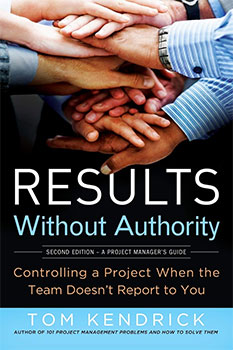
Results Without Authority

Controlling a project when the team doesn’t report to you

Results Without Authority - Controlling a project when the team doesn't report to you

One Sentence Summary: Today in large organizations, it is rare that the project lead has supervisory power over all the people on his project team. He must, however, maintain enthusiasm, motivation and results from people without being able to use the power of his position and powers of coercion; this book teaches us numerous techniques to do so.

By Tom Kendrick, 245 pages, 2006.

Summary and Book Review :

Note: This book is very heavy, in a very classic academic format (translate: irritating) and very focused on large corporations, I read it using the rapid reading techniques of 10 Days to Faster Reading, notably scanning and scraping. I am giving you a quick summary, which I hope will be sufficient for you to get a good idea of the book’s contents.

Projets are everywhere. Some are successful, others are not. And many projects fail because the project lead cannot control things well enough to bring them to their final conclusion. Projects today often take place in complex environments where the project lead does not have formal authority over the members of his project team. And even those that do, there is always a part of the project that falls to someone who doesn’t have this authority. Fortunately, it is possible to control a project and make it successful by using techniques that don’t depend on your position in the organization or your formal authority. Let’s take a look at them.

(more…)

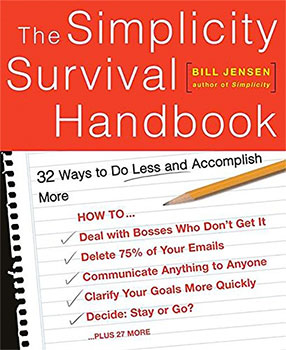
The Simplicity Survival Handbook – 2

The Simplicity Survival Handbook - 32 Ways to Do Less an Accomplish More

 Note: Because this is a thick, very detailed book full of “how-tos” and designed not to be read from cover to cover, coming up with a useful summary is long and takes time. I am therefore publishing it in two parts, of which this is the second. The first is here ;) .

Summary and Book Report, Part Two:

  • 17 : How to Pile With Managers Who Pile It On : MoreMoreMore, Now !

    • Courage : 6
    • Difficulty: 6.5
    • Yield: 9

    Managers who don’t manage priorities or focus your work abdicate the responsibility that they have towards you. But associating with your manage will reduce your workload. Complaining won’t take care of it.

    For this:

    1. Before going to talk to your Boss or your manager: create your job. Figure out exactly what work is superfluous, starting with how many goals are excessive, and where you think your efforts should be more concentrated.

    2. When you meet with your manager, understand the pressures that he or she might be under. A little bit of sugar helps the medicine go down if it is somewhat bitter.

    3. Ask: “Can we determine what the three most important things are that I should focus my priorities on in the next few [days, weeks, months]?

    Continue to shorten the timelines rather than get into a conflict over the long list of things that your manager needs to do. Say: “Boss, thank for you helping me to see that there are only 347 things to do this month. Now, can we discuss what needs to be done by this Friday?… Only 47 thinks! Cool! Now, what are the three things that I should attend to first?”

  • 18 : How to Deal with Teammates Who (Unknowingly) Pile It On

    • Courage : 4
    • Difficulty: 5.5
    • Yield: 9

    Your best friends and teammates don’t want to give you additional things to do. Really! But right after unfocused managers, your biggest source of additional work comes from well intentioned colleagues.

    To avoid this:

    1. Trust your instinct, not your head.

      1. Clarify the upcoming to-do list for the team. Concentrate on the short term – the do-dos for the next few days or next few weeks. Focus on these two things:

      • Clarify how the team’s to-do list is tied to general success. Use rules 5 and 11 for this.
      • Clarify how this to-do list for the team is going to help you pass the project to someone else. Use rules 3 and 5 for this.
    2. Shhh. Don’t tell anyone that you that are in the middle of reporting or deviating from things. You are about to be applauded for helping everyone get focused.
    3. Enjoy! Celebrate! You have just succeeded in taking an important step in your career.

    (more…)

  • The Simplicity Survival Handbook – 1

    The Simplicity Survival Handbook - 32 Ways To Do Less And Accomplish More


    One Sentence Summary: In life there is theory and practice, and there are things that “usually” work a certain way, that in actual practice work differently; discover how things really work in the professional world by exploring these 32 Ways To Do Less and Accomplish More and have a more productive and calmer life.

    By Bill Jensen, 300 pages, 2003.

    Note: Because this is a thick, very detailed book full of “how-tos” and designed not to be read from cover to cover, coming up with a useful summary is long and takes time. I am therefore publishing it in two parts, of which this is the first ;)

    Summary and Book Critique:

    In my recent critique of  Cut to The Chase, I asked myself about the relevance of collections of rules, given that most of the rules in these books are certainly interesting, but are of the “in one ear and out the other” variety and that this type of book has difficulties getting into the subject deeply. I wondered if the best way to use them was rather to put them on your desk, choose one rule a day, and try to apply it that day – you could also do one rule a week.

    Well, apparently Bill Jensen asked himself that question before writing his book because this is designed to be put into practice after spending a minimal amount of time reading it. Firstly, the author begins by strongly recommending 3 rules to use his book in the simplest and most efficient manner possible.

    It’s the first time that I have ever seen a book begin by advising you to absolutely not read all of it! ;)

    What’s more this book has an unusually interesting and original format that uses highlighting for the contents (at the moment only  The Creative Habit and 45 Effective Ways for Hiring Smart can claim as much among the books in my challenge). Actually, every chapter begins with a “Less-O-Meter”, a “Doing Less Counter” which gauges the courage required, the difficulty of the task and the amount that applying this tip/method will yield on a scale of 1 to 10:  Less-O-Meters 

    The author did not guess at the values. He asked 260 people over the course of 6 months to evaluate, test and change everything in the book, then he asked them to rate each rule on the three criteria. The rating provided is the average of the ratings for all 260 people.

    Moreover, the book uses pleasantly different fonts and font sizes, it is also filled with drawings – often funny – and explanatory diagrams of all kinds:

    Inside the problem

    And finally each rule is presented in the same format:

    1. The “Less-O-Meter”
    2. Why you should do less
    3. How to do less 
    4. Optional : To get more out of it, often accounts and real-life situations of people who have lived this in a company setting.   
    5. Optional: Want More ? , additional resources for those who want more. 

    The format is therefore brilliant, absolutely brilliant, there is no other word. Because of it, everyone can make their own “mini-book,” read what interests them and begin to apply it. But what’s inside? Let’s take a look:

    (more…)

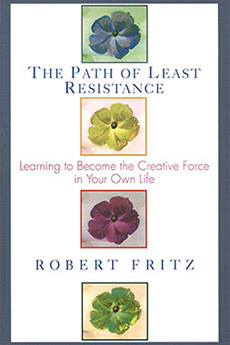
    The Path of Least Resistance – Learning to Become the Creative Force in Your Own Life – 2

    image

     The Path of Least Resistance - Apprendre à Devenir la Force Créative de Votre Propre Vie

    One Sentence Summary: Our freedom in life, like our freedom of movement in a building, is partly defined by its structure, thus to be able to create our life, and move towards our ideal, it is better to change its structure rather than change our behavior within the same framework, this book teaches us to do so by showing how we can create a structure in our life, which draws us inexorably, and almost effortlessly, along the path of least resistance- and pushes us to create what we really want for ourselves.

    By Robert Fritz, 285 pages, 1984 (first edition), 1989 (current revised edition).

    Note: Because this book is extremely heavy and interesting, and somewhat dry (translation: difficult to summarize :) ), I am posting it in two parts. This is the second part (the first part is here).

    Summary and Book Report:

    Part 2 – The Creative Process

    • Chapter 11: The Creative Cycle

    There are three major steps in the creative process of constructing your life and its development:

    1) Germination. Full of a particular energy – an energy characteristic of new beginnings – this step is the ideal moment to act. Motivation, excitement and enthusiasm are at their zenith. Unfortunately, most personal development approaches focus on this step exclusively, and while it’s certainly vital it can’t produce sufficient results on its own. Numerous people get stuck at the peak of the energy that comes with this step and procrastinate over the next steps, ultimately forgetting them amongst other activities and never truly advancing.

    2) Assimilation. this step is crucial, but it’s the least obvious in human development – particularly in its beginning phases. What we’ve created grows organically during this time, developing within us and calling upon our internal resources while we work on developing it. We teach ourselves our vision – a vision that goes beyond beginner status and becomes like an old friend. This is how intuitions, ideas and connections appear.

    3) Achievement. Completing what we create is a step that few people master. We all know people who haven’t finished what they’ve started, sometimes even with very important projects, and we’ve all surely been there ourselves. This step is characterized not just by the completion of our creation, but by the fact of learning to live with it as well.

    (more…)

    The Path of Least Resistance – Learn to Become the Creative Force in Your Own Life -1

    image

     The Path of Least Resistance - Learn to Become the Creative Force in Your Own Life

    One Sentence Summary: Our freedom in life, like our freedom of movement in a building, is partly defined by its structure, thus to be able to create our life, and move towards our ideal, it is better to change its structure rather than change our behavior within the same framework, this book teaches us to do so by showing how we can create a structure in our life, which draws us inexorably, and almost effortlessly, along the path of least resistance- and pushes us to create what we really want for ourselves.

    By Robert Fritz, 285 pages, 1984 (first edition), 1989 (current revised edition).

    Note: Because this book is extremely heavy and interesting, and somewhat dry (translation: difficult to summarize :) ), I am posting it in two parts. Here is the first:

    Summary and Book Report:

    Robert Fritz is an American composer, director and screenwriter, and creator of the Technologies for Creating concept that he teaches in the company he created, and that he shares with us in this book.

    He begins by telling us that the roads from downtown Boston appear to have no precise structure. Yet they are built on former cow trails that existed in the 17th century. The cows were content to put one leg in front of the other, but once they had been to a place, it was easier to return, because the path was increasingly more useable and defined. The cows followed the nearest path that was easiest for them – that of least resistance. Thus, the structure of the plains and the path of least resistance for seventeenth century cows still determines the organization and construction of urban Boston today.

    Note: Although it seems that downtown Boston is effectively a shambles, and a source of numerous outcries by its inhabitants, the history of the cows is an urban legend. The image is none-the-less valuable for explaining that unsuspected structures – created by forgotten paths of least resistance – influence our behavior every day.

    Therefore, energy goes where it is easiest for it to go. It is a fundamental point on which the whole book is built, and from which flow the three following ideas and insights:

    1. We move through life by taking the path of least resistance.
    2. The underlying structure of our lives determines the path of least resistance.
    3. We can change the underlying fundamental structures of our lives.

    Out of these three insights comes this guiding principle: We can learn to recognize the structures that play a role in our lives and change them in order to create what we really want to create.

    In a very structural and systemic manner, Robert Fritz explains that structure refers to both its elementary components, as well as how those components interact with each other and with the global framework that they form, the whole being more than the sum of its parts.

    This may seem complicated, but let’s take an example: the human body. The human body is made up of many very different elements, and each has a specific function: the brain, heart, lungs, red blood cells, nerves, muscles, etc., all interacting with each other on different scales to create a whole which is much more than the simple sum of its parts. Anything that affects one element can affect other elements at the same time, and the whole system, all the components, are in related to one another, and doctors and surgeons learn to think of the body as a system and structure.

    Thus, a surgeon who operates on one organ is not only concerned with the state of the organ itself, but also the whole body of which it forms a part, and he takes factors into account which may be completely external to this organ – such as blood pressure, brain waves, the presence of bacteria, allergic reactions …

    Everything has an underlying structure, whether physical, as with bridges or skyscrapers, or intangible, as with the plot of a novel or the form of a symphony. Our life has a structure, it consists of multiple factors interacting with each other and with the structure itself.

    So the structure determines the movements and behavior of the objects that it consists of, and certain structures are more useful than others for getting the desired results.

    How can you change the structure? By creating it. Often we think in terms of solving problems, but this approach only allows us to change some elements here and there without changing the structure, and the structure could then return the elements to their initial state. By creating we are changing the structure.

    When we try to solve a problem we are acting to remove something: the problem. When we create, we are acting to produce something: the creation. Therefore, by thinking structurally, rather than saying to ourselves "How can I make this undesirable situation go away?” we say to ourselves “What structure do I need to adopt to create the results that I want to create?”

    It is a radically different approach. The author explains it to us throughout his book, after having shown us the fundamental problems with the problem-solving approach. Let’s learn about it.

    (more…)

    GTD, Implementation – 1

    1 – Choice of central tool for the system – difficult

    This week, as promised, I am focused on implementing GTD. The least I can say is that it’s not simple. Especially due to the number of available electronic applications, and because I want to, and must, have a system for collecting and processing that is reliable, which I can count on, and which meets my requirements. I have identified my primary requirements and needs as the following: The system must allow me to:

    (more…)