Books that can change your life Rotating Header Image

Organization

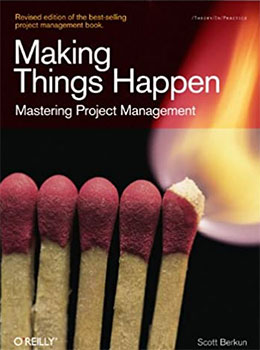
Making Things Happen – 2

Making Things Happen - Maîtriser le Management de Projet

Note: because this book is both heavy and complex, I am publishing the summary in two parts. Here is the second part, the first part is here.

Summary and Book Review, second part:


  • Chapter 9 : Communication and relationships

For a long time during our civilization, the slowness of communications posed several problems. Many disasters and misunderstandings arose from this situation. Today, communication is still important, but two things have changed:

  • Speed is no longer the main problem (what could be faster than an instant message?) Instead, it is quality and efficiency of communication that have assumed primary importance.
  • Communication is not enough for complex work; you also need effective relationships between people who work together.

Even though there are often clearly defined leaders who sometimes give orders, projects depend heavily on the team’s ability to use each other’s knowledge, to share ideas and to work in a synchronized way, as opposed to being based on overly strict lines of authority, rigorous discipline and the need to follow orders without asking questions.

Because project leads spend a lot of time communicating with individuals and groups, they have more responsibilities that require them to communicate effectively with respect to the team. This does not require the extrovert personality of a TV presenter, an extraordinary sense of humor or magical powers (although they may help). Rather, it starts by admitting that communication and interpersonal skills are critical for success, and that there is room for improvement for you and your team.

Additionally:

  • Projects are not accomplished by communication alone. In these modern times, speed is not the Achilles heel of communication. Quality is.
  • Interpersonal relationships improve and accelerate communication.
  • There are several types of communication that people use to communicate with each other. Project managers must be familiar with them in order to be able to diagnose and resolve communication problems.
  • There are numerous common communication problems, like assumptions, lack of clarity, not listening, personal attacks or blame.
  • Role Definition is the easiest way to improve interpersonal relationships.
  • Ask people what they need to do a better job. Ways of doing so include: listening, removing barriers, teaching and reminding them of the objectives.
  • Relationships between people and communication are not low priority efforts. They are essential to all individual activities that take place during a project.

Exercise :

Make two ordered lists, one with the most important people on your team, the other with those on your team with whom you have the best relationship. Find opportunities in the two lists to improve your relationships; if you could improve your relationships by 25%, what would be the biggest impact to your project?


  • Chapter 10 : How not to annoy people, process, email and meetings

The bigger your team, the more likely the chances of annoyting someone. Whenever you are following someone else’s work, or making decisions that impact others, you have the potential to annoy them. If you are smart, you will find ways to minimize disagreements. People will be happier, the project will go more smoothly, and you will have fewer black looks when you pass people in the hallways.

The three activities that annoy people the most are email, meetings and team processes (like build or specification procedures).

Additionally:

  • Project managers are inclined to annoy others. Some things could be avoided.
  • People get annoyed for many reasons. Often it when they believe their time has been wasted, when they are treated like idiots, or when they are expected to put up with a prolonged annoyance or poor treatment.
  • Good processes have many positive effects, which include accelerated progress and the prevention of problems. But they are difficult to develop.
  • An email which is not annoyting is concise and actionable (it contains an action), and it quickly allows readers to figure out if they care enough to read more than the email header or the first sentence.
  • Meetings are conducted well when someone runs them.
  • Frustrating meetings result when the objectives are not suited to that type of meeting.

Exercise:

When was the last time you complimented someone for their clear, simple emails? Next week, every day, thank the person who sends you the clearest, most effective email.


  • Chapter 11 : What to do when things go wrong

No matter what you do, no matter how hard you work, or who you work with, things will sometimes go wrong. The best team in the world, with the best leaders, workers, resources and the best morale, will find itself in difficult situations. The only way to completely avoid difficult situations is not to do anything important or to put yourself permanently into situations or projects in which you are protected from all forms of risk – two things which rarely contribute to success.

Good project managers must therefore be prepared to manage difficult situations. That requires a certain amount of wisdom to understand that when bad things happen, it is what it is. There is nothing you can do after the fact to change it. Instead, how the team reacts to adversity can be a more important factor to success than the team’s ability to prevent problems. Both are important but resilience and recovery are the abilities that give you the ability to manage the possible unknown. Without them, the best team and the best plan can spiral out of control with the slightest push in the wrong direction.

Additionally:

  • If you can remain calm and break the problem into smaller pieces, you can manage many difficult situations.
  • There are some actual situations that you can anticipate, like errors due to not paying attention, being forced to do stupid things, lack of resources, poor quality, a change in direction, personnel problems, and the desire to mutiny.
  • Difficult times are learning opportunities. Make sure that you and your team take the time to analayze what happened and how it could have been avoided.
  • Taking responsibility for situations, without worrying about who caused them, always helps to resolve them more quickly.
  • In extreme situations, put yourself in “damage control mode.” Do whatever is needed to get the project back into a stable state where it is understood.
  • Negotiations are not only useful in crisis situations, but also for managing. Good negotiators work towards people’s interests, not their own positions.
  • Keep a clear perspective on who has what authority at all times. People need to know who has the power to make decisions before a crisis occurs.
  • People react to pressure in different ways. Be observant and open in how you help your team manage different types of pressure.

Exercise:

Go into the office and find five things that could go wrong. For each one, describe how you are going to manage the problem if you are assigned the task to fix it. Who needs to be in the room to manage the problem? What will you do if you are not in a position of power?

Part 3 : Management


  • Chapter 12 : Why leadership is based on trust

As far as leading your team is concerned, everything depends on the assumptions that people make about you. When you say “I will make sure that gets done tomorrow” or “I am going to speak to Carol and get her to agree,” others will silently calculate the probability that what you say is true. Over time, if you are serving your team well, the probability will be perceived as very high. They will believe your work and trust you.

Even though in the movies leaders are portrayed as having a dramatic role – such as throwing themselves into burning buildings or bravely fighting alone against a whole host of enemies – true leadership is based on very simple and practical things. Do what you say you will and say what you mean to say. Admit when you are wrong. Incorporate the opinions and ideas of others in decisions which impact them. If you can do these things, more often than not you will earn the trust of those you work with. When the time comes for you to ask them to do something unpleasant or which they don’t agree with, their trust in you will make your leadership possible.

Therefore, to be a great leader, you must learn how to find, build, earn and give trust to others – as well as learn to cultivate trust in yourself.

Additionally:

  • Trust is built on effective commitments.
  • Trust is lost through inconsistent behavior towards important issues.
  • Use authority and trust to allow people to do a good job.
  • Institutional power comes from the company organizational structure. Power of recognition comes solely from people’s response to your actions. Recognition power is the most useful institutional power, although both are necessary.
  • Delegate in order to build trust in your team and to assure yourself that your team is united in the face of adversity.
  • Deal with problems in a way that will keep people’s trust. Be supportive during crises so that they will tell you problems rather than hide them from you.
  • Having confidence in yourself is the foundation for leadership. Self-discovery is the way to learn who you are and to develop a healthy independence.

Exercise:

Make a list of the 5 people that you work with the most. Who do you trust the most and why?


  • Chapter 13 : Making things happen

The ability to make things happen is a combination of knowing how to be the catalyst in a variety of different situations, and having the courage to do so.

Additionally:

  • Everything can be represented in an ordered list. Most of the work of project management is assigning the right priority to things and leading the team to get them done.
  • The three basic ordered lists are: the project objectives (vision), the list of functions and the list of work items. They must always be synchronized with each other. Each work task contributes to a function and each function to an objective.
  • There is a bright yellow line between the priority of what I am working on and all the rest.
  • Things happen when you say no. If you don’t say no, you have not effectively prioritized.
  • The project manager must make it so that the teams stays honest and close to reality.
  • Knowing the path of least resistance in engineering and in team processes allows for efficiency.
  • You must be both tough and smart to make things happen.

Exercise :

Who in your organization has the reputation for making things happen? How did they earn it? And who are the people with a reputation for not making things happen? Is there a relationship between their position in the organization and their ability to make things happen?

[ad#ad-bas]

  • Chapter 14 : Middle-game strategy

Just as in the middle game when playing chess, the middle of a project is the moment when a lot of things happen at the same time, and it’s difficult to keep a clear perspective about what is going well and what is not going well. To fight this inevitable fog that surrounds the team and makes inexperienced people get easily lost, you must apply these three simple principles:

  1. If things are going well at the end of the first day, the objective for the next day is to make it so that things continue to go well.
  2. If on any day the project is not going well, it’s your job to figure out what the problems are and to act so that the project goes well again. This can take hours, days or weeks.
  3. Repeat until the project is finished.

The problem is that you only have a limited amount of time to understand what the problems are and even less time to solve them. Not to mention the effort needed to protect the healthy parts of the project from the problems. For these reasons, and more, stress and energy levels in the middle of the game are very high. The team is moving at an ever increasing pace, and the acceptable margins of error are going down on a daily basis.

Additionally:

  • Projects are complex non-linear systems and have significant inertia. If you are expecting to wait until problems are serious before acting, you will be late and might make things even worse.
  • When your project is out of control, you are flying behind the plane, which is a bad place to fly. There are both tactical and strategic points to be verified.
  • Think about how to act to correct a situation in the best possible way. The bigger the action, and the further along the project, the more dangerous the action can be.
  • Schedules based on milestones provide opportunities to make corrections for project paths that are more certain.
  • Configuration control is how you manage change acceleration from a low level and an intermediate level on the project.

Exercise:

If you are in the middle of a project now, take five people at random from your team and ask them to describe their confidence in the schedule in the form of a percentage. Do the same thing with five managers. Compare the results and present them at a team meeting. If it’s useful, do it every week. Make it so that the descriptions are anonymous so that people will be honest.


  • Chapter 15: End-game strategy

When the end of the project is near, someone must find a good way to apply the brakes in order to slow down the progressive movement so that things end well.

Additionally:

  • A big target is a series of little targets.
  • Every milestone has three smaller targets :
    • Design complete (specifications complete)
    • Functions complete (implementation complete)
    • Milestone complete (quality assurance and refinement complete)
  • Defining the exit criteria at the beginning of the milestone increases the ability of the team to finish on time.
  • Being on schedule is just like landing an airplane: you need a long, wide approach. And you better be ready take off again quickly, without having to make major repairs..
  • You need metrics to track the project. Common metrics include day to day work, bug management and the business charter [?].
  • You need control elements to adjust the levels of a project. Common elements include review meetings, tries, and centralized decision making at the end of the project.
  • The end of the game is a slow and difficult process. The challenge is to reduce the scope of the changes until you have a satisfactory finished product.
  • Now is the time begin the postmortem process. Give yourself, as well as your team, the benefit of learning from what went well and what didn’t go well.
  • If fortune is smiling on you, and your project works out, be happy. Very, very happy. A lot of people, even though it is not necessarily their fault, don’t get that far. Look forward to a great night out. Do something fun and extravagant (like inviting the author of the book to a party). Provide stories that will be told for years to come.

Exercise:

You are two days away from a major news release on your news site, used by millions of people. The champagne is ready and waiting. But an engineer discovers a major problem which is going to take three days to fix. The problem is the 10 million dollars spent on publicity for the launch date and the time already spent. What will you do?


  • Chapter 16 : Power and Politics

Every time you try to organize people to do something, whether it is to get ready for a party or start a business, the people concerned have different attitudes, skills, and different desires. This means that it doesn’t matter how talented the leader of a project is, there will always be people who won’t get what they want. Therefore, there is a natural instinct in ambitious and motivated people to try and get what they want by influencing the people with the power to get things done.

The fuel that propels politics is power. Someone who can influence the right person at the right time, and who uses his knowledge to resolve situations to everyone’s satisfaction, can be more powerful in an organization than those who are at the top – sometimes without even knowing it.

For project managers this means two things:

  1. There will be political influences that impact you, whatever your power or your personal ethic.
  2. Power and politics are an inherent part of management.

You must therefore at least be conscious of how political systems work if you want to reduce their negative effects, not to mention if you want to increase their positive effects.

Additionally:

  • Politics is a natural consequence of human nature. When people work together in groups there is a limited amount of authority which can be distributed amount different people with different wishes and different motives.
  • All leaders have political constraints. Every executive, CEO or president has peers or superiors who limit their ability to make decisions. In general, the more power someone has, the more complicated are the constraints upon it.
  • There are many different types of political power, like rewards, coercion, knowledge, references, and influence.
  • Power is misused when it is applied to things that do not further the objectives of the project. A lack of clarity with respect to the objectives, loosely allocated resources, or unclear decision processes can contribute to this misuse of power.
  • To resolve political problems, be clear about what you want. Identify who has it, and then evaluate hoq you can get it.
  • If you are involved in project management, you lay out a political playing field around you. It’s up to you to decide up to what point it is honest or unfair.

Exercise:

Is it possible to work with other people and have nothing to do with politics? Think of a work environment with the healthiest political environment possible. What makes it possible?

Book Review:

This book is heavy. Very heavy. 370 wide pages, full of text, with some diagrams here and there. Fortunately, the author takes his work very seriously, but he doesn’t take himself too seriously, which means that his book is sprinkled with nice, humerous sentences which lighten it all up somewhat.

In the end, I have trouble judging because, other than directing a small business, I have never managed projects of the human and technical complexity levels that the author is talking about. Furthermore, this book is clearly geared more towards people who work in large organizations, just like Results Without Authority, and even more specifically to people who work in the software development field, even though the author visibly does his best to be as general as possible – but there are so many references to the software industry that he does not achieve his objective.

I would say, therefore, that it is obvious from reading this book that Scott Berkun is someone who has a lot of experience in this subject and that he has mastered it exceedingly well. I know that one day I will have to manage more complex development projects than those in my current company, and I won’t hesitate to dive into this book to pull out the tricks and ideas or find answers to specific problems. This book therefore has a place on the bookshelf for all project managers who work in large organizations. Once again, for $39.00, if this book only gives you one good idea, it will largely pay for itself. If you are a project lead in the software industry, dig in. This book is made for you ;

Strong points:

  • Very thorough
  • Sprinkled with humorous phrases which lighten it up
  • The author has obviously mastered his subject down to the tips of his fingernails
  • Geared towards the software industry, but contains advice and methods applicable to the management of any project in a large organization.

Weak Points:

  • Very, very heavy
  • A little too geared towards the software industry
  • A little too geared towards large organizations

Translated by www.DeansResource.com

    My rating: image image imageimageimageimageimageimageimage (if you are called to lead projects in large organizations – add a star if your company is in the software industry)

    image image imageimageimageimageimageimageimage (if you are called to lead projects in another field)

    Have you read the book? How do you rate it?

    Mediocre - No interestReasonable - One or two interesting paragraphsIntermediate - Some goods ideasGood - Had changed my life on one practical aspectVery Good - Completely changed my life ! (1 votes, average: 5.00 out of 5)
    Loading ... Loading ...

    Read more reviews about Making Things Happen on Amazon.

    PMBA Challenge:

    Cost of the Book:

    € 31.24

    Total cost of the project:

    € 217.77

    Number of pages:

    370

    Total number of pages:

    3061

    Time to read it:

    3H

    Time to write this article:

    8H

    Total time for the project:

    114H30

    Buy this book on Amazon:

    Making Things Happen


    Making Things Happen - Mastering Project Management

    One Sentence Summary : Project management is a complicated art which requires you to master a number of things such as planning, understanding what needs to be done, writing a good overall vision statement, understanding where ideas come from, understanding what to do with ideas, writing good specifications, understanding how to make good decisions, communication and interpersonal relationships, what to do when things go badly, understanding why leadership is built on trust, making things happen, managing the strategy in the middle and at the end of the project, or understanding questions of power and politics; this book describes in detail each of these components and gives us numerous methods and tricks for mastering them.

    By Scott Berkun, 2008, 370 pages.

    Note : Since this book is both thick and complex, I am publishing the summary in two parts. This is the first.

    Summary and Book Report:

    Scott Berkun is an author and speaker who has worked at Microsoft for 9 years as a project manager going from Internet Explorer (1 through 5), Windows and MSN. In 2005 he published the first version of this book, The Art of Project Management, which was centered more around project management in the area of software development and the phenomenal success of which, for a book of this type, led to this revision, in which the subject is more general and touches on general project management, for any sector.

    Every chapter ends with a list of exercises – extremely relevant – to reflect on the subjects dealt with and put them into practice. I am giving you one at the end of each chapter summary.

    The author begins by telling us that the idea of project management goes back a long way in human history. Everything that humanity has built, from the Egyptian pyramids or the Roman aqueducts up to a Boeing 777 or the Hubble space telescope, have been designed and then implemented. Between these two stages is found the art of leading long and complex projects to fruition.

    The author wonders if there were points in common between all these projects, if he could find common denominators. He did not always find obvious answers, but each time that he returned from his quests into the past to dive into the world of software development, his own tools and processes appeared differently to him. And there were three lessons that he drew from these expeditions:

    1. Project management is not a holy art. All modern engineering work is a new foray into history and things already realized. Technology and skills might change, but the central challenges remain the same. Everything is both unique and derived from something else. In order to be able to re-use past knowledge, you must be open to both.
    2. The simpler your vision of what needs to be done, the greater your power of concentration to accomplish it. If we keep a simple vision for our work, we can find useful comparisons with other ways of doing things all around us. It’s a similar concept to what the Japonese call shoshin, or keeping a beginner’s mind - an open mind – which is an essential element in martial arts. Staying open and curious is what makes growth possible. In order to continue learning, we must resist the temptation to succomb to the safe and narrow visions with regard to what we are doing.
    3. Simple doesn’t mean easy. The best writers, athletes, programmers, and managers tend to be people who see what they do as simple by nature and difficult at the same time. For example, it is simple to run a marathon. You begin running and you don’t stop until you have completed 40 kilometres (26 miles). What could be simpler than that? The fact is that the difficulty of it does not reduce its simplicity. Leadership and management are also difficult, but their nature – making it so that things happen in a specific way towards a specific objective – is simple.

    Additionally:

    • Project management might be a job, a role or an activity.
    • Leadership and management require understanding and intuitive knowledge of numerous common paradoxes, such as:
      • Ego/No-ego: The ego can be a driver for managers, who often derive great personal satisfaction from their work. However, managers must avoid placing their own interests above those of the project, and must delegate important and fun tasks, and share the rewards.
      • Autocrat/Delegator: In certain situations, the most important things are strong and clear authority and a quick response time, and the manager must have the necessary confidence and the will to take control and force certain actions. However, the general objective must be to avoid these situations.
      • Oral/Written: Even though many organizations today are email-centric – notably software development companies – oral communication is still important, there are always meetings, negotiations, hallway discussions, and brainstorming sessions. In general the larger the organization or project, the more writing skills are important. But a good manager must recognize when written or oral communication will be more efficient.
      • Courage/Fear: One of the biggest misconceptions of our culture is that people who are brave don’t experience fear. That’s a lie. A brave person is one who feels fear but chooses to act anyway.
    • If you are a dedicated manager, find ways to capitalize on your unique perspective of the team and the project.
    • In the end, all projects use similar processes; they all allow time to plan, implement and refine.

    Part 1: Plans

    • Chapter 2 : The Truth About Schedules

    (more…)

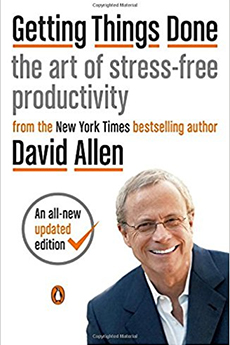
    Getting Things Done – The Art of Stress-Free Productivity

    image

    Getting Things Done - The Art of Stress-Free Productivity

    One-Sentence Summary: To be efficient, your mind must be crystal clear, like spring water; to get to that point you need to get rid of all the parasitic thoughts that permanently distract you, which you can accomplish by putting  everything that you want to, or must do into an external automated system, thus relieving your brain of the need to think – which it does badly, without directed prioritization and without consciously choosing the right moment.

    By David Allen, 272 pages, published en 2001.

    Summary and Book Report:

    Let’s get right to the point: the GTD method is famous in the United States, it is a best seller and features in numerous web-based resources, whether in the form of articles to help you get things done  or software to go with it (there are over forty currently, for all platforms, and most are free!) I have also translated [into French] different articles on using it on my blog, Habitudes Zen, which allowed me to understand the method before reading the book.

    The author, who has been a business management and productivity consultant for 20 years, begins by showing that the working world has evolved and that managers often have to multi-task to get several things done at once, and even if they could dedicate their whole life to it,  no doubt they would not have enough time to do things as well as they would prefer. What’s more, numerous organizations have had their internal boundaries eroded, and their effectiveness rest on endless collaboration and communications using different services – and you can no longer avoid any of the many mail services in use. Executives therefore generally need to multitask more than before. This evolution by organizations must necessarily come with new tools and new work approaches.

    Imagine if you could do, if you could choose to focus completely on your tasks, without any interruptions, parasitic thoughts, daydreams and other sources of distraction, while remaining alert and in full possession of your faculties. Sound like a dream? It’s possible. David Allen recommends with his method something that martial arts practitioners call “mind like water,” or athletes call “in the zone”, a state of mind that is free from worry and totally focused on the goal you want to reach. You have no doubt already experienced it at times. Were you able to perform better, feel more satisfied with yourself and your accomplishments in that moment? David Allen recommends a system to make those moments the norm. Let’s see how.

    (more…)