Books that can change your life Rotating Header Image

rules

The Simplicity Survival Handbook – 2

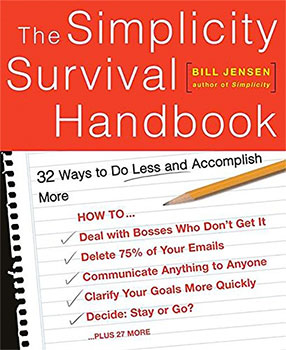
The Simplicity Survival Handbook - 32 Ways to Do Less an Accomplish More

 Note: Because this is a thick, very detailed book full of “how-tos” and designed not to be read from cover to cover, coming up with a useful summary is long and takes time. I am therefore publishing it in two parts, of which this is the second. The first is here ;) .

Summary and Book Report, Part Two:

  • 17 : How to Pile With Managers Who Pile It On : MoreMoreMore, Now !

    • Courage : 6
    • Difficulty: 6.5
    • Yield: 9

    Managers who don’t manage priorities or focus your work abdicate the responsibility that they have towards you. But associating with your manage will reduce your workload. Complaining won’t take care of it.

    For this:

    1. Before going to talk to your Boss or your manager: create your job. Figure out exactly what work is superfluous, starting with how many goals are excessive, and where you think your efforts should be more concentrated.

    2. When you meet with your manager, understand the pressures that he or she might be under. A little bit of sugar helps the medicine go down if it is somewhat bitter.

    3. Ask: “Can we determine what the three most important things are that I should focus my priorities on in the next few [days, weeks, months]?

    Continue to shorten the timelines rather than get into a conflict over the long list of things that your manager needs to do. Say: “Boss, thank for you helping me to see that there are only 347 things to do this month. Now, can we discuss what needs to be done by this Friday?… Only 47 thinks! Cool! Now, what are the three things that I should attend to first?”

  • 18 : How to Deal with Teammates Who (Unknowingly) Pile It On

    • Courage : 4
    • Difficulty: 5.5
    • Yield: 9

    Your best friends and teammates don’t want to give you additional things to do. Really! But right after unfocused managers, your biggest source of additional work comes from well intentioned colleagues.

    To avoid this:

    1. Trust your instinct, not your head.

      1. Clarify the upcoming to-do list for the team. Concentrate on the short term – the do-dos for the next few days or next few weeks. Focus on these two things:

      • Clarify how the team’s to-do list is tied to general success. Use rules 5 and 11 for this.
      • Clarify how this to-do list for the team is going to help you pass the project to someone else. Use rules 3 and 5 for this.
    2. Shhh. Don’t tell anyone that you that are in the middle of reporting or deviating from things. You are about to be applauded for helping everyone get focused.
    3. Enjoy! Celebrate! You have just succeeded in taking an important step in your career.

    (more…)

  • The Simplicity Survival Handbook – 1

    The Simplicity Survival Handbook - 32 Ways To Do Less And Accomplish More


    One Sentence Summary: In life there is theory and practice, and there are things that “usually” work a certain way, that in actual practice work differently; discover how things really work in the professional world by exploring these 32 Ways To Do Less and Accomplish More and have a more productive and calmer life.

    By Bill Jensen, 300 pages, 2003.

    Note: Because this is a thick, very detailed book full of “how-tos” and designed not to be read from cover to cover, coming up with a useful summary is long and takes time. I am therefore publishing it in two parts, of which this is the first ;)

    Summary and Book Critique:

    In my recent critique of  Cut to The Chase, I asked myself about the relevance of collections of rules, given that most of the rules in these books are certainly interesting, but are of the “in one ear and out the other” variety and that this type of book has difficulties getting into the subject deeply. I wondered if the best way to use them was rather to put them on your desk, choose one rule a day, and try to apply it that day – you could also do one rule a week.

    Well, apparently Bill Jensen asked himself that question before writing his book because this is designed to be put into practice after spending a minimal amount of time reading it. Firstly, the author begins by strongly recommending 3 rules to use his book in the simplest and most efficient manner possible.

    It’s the first time that I have ever seen a book begin by advising you to absolutely not read all of it! ;)

    What’s more this book has an unusually interesting and original format that uses highlighting for the contents (at the moment only  The Creative Habit and 45 Effective Ways for Hiring Smart can claim as much among the books in my challenge). Actually, every chapter begins with a “Less-O-Meter”, a “Doing Less Counter” which gauges the courage required, the difficulty of the task and the amount that applying this tip/method will yield on a scale of 1 to 10:  Less-O-Meters 

    The author did not guess at the values. He asked 260 people over the course of 6 months to evaluate, test and change everything in the book, then he asked them to rate each rule on the three criteria. The rating provided is the average of the ratings for all 260 people.

    Moreover, the book uses pleasantly different fonts and font sizes, it is also filled with drawings – often funny – and explanatory diagrams of all kinds:

    Inside the problem

    And finally each rule is presented in the same format:

    1. The “Less-O-Meter”
    2. Why you should do less
    3. How to do less 
    4. Optional : To get more out of it, often accounts and real-life situations of people who have lived this in a company setting.   
    5. Optional: Want More ? , additional resources for those who want more. 

    The format is therefore brilliant, absolutely brilliant, there is no other word. Because of it, everyone can make their own “mini-book,” read what interests them and begin to apply it. But what’s inside? Let’s take a look:

    (more…)

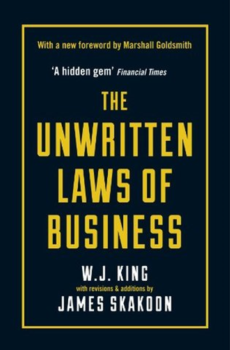
    The Unwritten Laws of Business

    image

    The unwritten laws of Business - Couverture 

    One Sentence Summary: To succeed in your career, you must understand and apply many unwritten rules with respect to the work, the chain of command, colleagues, project management, the organizational structure, what managers expect from their subordinates, character, personality, and personal development; sometimes these laws seem obvious but even so, those presented in this book are regularly forgotten.

    By W.J. King, with revisions and additions by James G. Skakoon, 100 pages, published in 1944 (first edition under the name The Unwritten Laws of Enginnering), and in 2001 (current revised edition).

    Summary and Book Report:

    This little book (size-wise) is the epitomy of a universal short and concise text that has outlasted generations and specializations. First published in 1944 under the name The Unwritten Laws of Enginnering, was republished under the same title in 2001 after some touching up.

    It’s story becomes fascinating after that: William H. Swanson, CEO of the huge American defense corporation, Raytheon (73,000 employees) released a book in 2005 entitled Swanson’s Unwritten rules of Management, which the New York Times showed to be a plagiarism of the 1944 classic. Before this revelation, the book was very successful, attracting positive reactions from leaders such as Warren Buffet (American billionaire and richest man in the world – ah yes! he has dethroned Bill Gates :) ) or Jack Welch (former CEO of General Electric).

    William Swanson acknowledged this and apologized. Suddenly, public attention was turned towards the original work, very intelligently renamed by its editor under its current title, which represents the universal appeal of its contents very well.

    Even though it was conceived by an engineer for engineers, the 63 recommended rules go beyond this sector and apply to anyone who ends up working in a team, whether you are at the very bottom or the very top of the ladder. Some may seem obvious, but according to the author, they are all without exception often forgotten within organizations, from small businesses to multinational corporations.

    Here are the 63 rules, summarized for the most post – I have not listed the ones that are pretty self-explanatory:

    (more…)